We have spent several days in the past two months modifying irrigation station "wiring". With the age of the system and subsequent old school philosophy of wiring techniques during that time, alterations and modifications can be a bit more time consuming than anticipated. The 1978 design specified many of the stations to consist of multiples of "paired" sprinkler heads. "Daisy chaining" as it is referred to by many is the connection of multiple sprinkler heads on one zone wire. To conserve on wire, the installation of these "chains" seldom followed the lateral pipe buried in the ground. The lack of splice boxes at the lateral lines and poor as-builts make tracing these wire paths a chore.
Over the past several years we have worked diligently to split or break the large chains of heads down to a manageable number for the hydraulics and programing of the central control system. This has improved our pressure at the sprinkler heads and reduced the "donuts" of dry turf in close proximity of the head that many members have shared "fond" stories of. We are down to addressing our final two zones operating (6) sprinkler heads a piece. Not only will I be happy, but the pump station flow ramp will appreciate the completion of this exercise as well.
Showing posts with label Irrigation. Show all posts
Main Line Leak
We recently repaired a leak in the 6" mainline in front of #13 tee. The damage to the pipe was caused by the wear of a rock in contact with the pipe. Typical practice is to backfill any/all pipe with rock free material to prevent this phenomenon from occurring. This leak is the second leak of it's kind in the past month. A similar repair was made on the 4" mainline on the left side of #2 fairway earlier in the month.
The PVC pipe that carries water throughout the course was installed in 1978. It has held up quite well, but it's wear is beginning to show with an age of 33 years. The typical life expectancy of an irrigation piping system is 10-30 years based on information provided by the ASGCA.
Landscape Irrigation Auditor's Class
This past December I participated in a two-day Landscape Irrigation Auditor seminar hosted by Ewing Irrigation in Irvine, CA. The event was a nice refresher on techniques and formulas utilized to determine "efficient" watering practices. Over the past three years, Greenway's efforts and auditing of Arrowhead Country Club's irrigation system has resulted in considerable savings in not only application efficiency and water consumption, but power savings as well. This past season, we consumed 11 acre foot less water on the property than in 2010. The 385 acre foot total usage on 90.2 acres of turfgrass is 4.27 acre foot per acre of turf. That is exceptional in our region based on soil conditions, length of season, and climate.
![]() |
| Soccer Field at a school in Irvine |
Improving D.U. (Distribution Uniformity)
One of the elements to water conservation is improving DU or distribution uniformity. Distribution uniformity is a measure of how uniformly water is applied over a given area. Sprinkler nozzles and sprinkler spacing greatly influence DU and have negatively impacted water consumption in the past. The lower the percentage of DU, the longer a sprinkler head will need to run to "flood" an area. The higher the DU percentage the less time a station or sprinkler will need to run to supply ample moisture based on ET. At ACC we have corrected spacing issues on all of the greens and upgraded the sprinkler nozzles to increase uniformity. The photo below is just a sample of the multiple nozzles present on the course. One major issue discovered was that the main blue/rear green nozzles prevalent on the course can only throw 58' optimally at our sprinkler base pressure. This poses a monumental problem when our sprinkler spacing is 70+ feet.
Ugh... Summer in the I.E.
We have had a relatively mild summer here in the Inland Empire. For those of you that follow this blog and were not aware, the weather in the Inland Empire is not at all similar to San Francisco, San Diego, or Los Angeles, but more like Palm Springs. The average high temperature from late May to early September is in the upper 90's. This past weekend, we experienced highs in the upper 100's: 108 F & 109 F. That drove soil temperatures at a depth of five inches to 90+ degrees. A little extra attention and some supplemental hand watering was all that was required. We still maintain root depths of 6-9" on our A4/T1 Bentgrass greens and feel fortunate that we are not managing poa annua.
San Bernardino County Water Conference 2011
This past Thursday I was invited to participate as a speaker and panelist at the San Bernardino County Water Conference in Ontario. It was an opportunity to inform the community of our water conservation efforts on the golf course. By introducing perpetual, comprehensive auditing to our conservation planning, we have conserved a volume of water equal to a 25% reduction from previous seasons (2006 versus 2010). That equates to 60 acre foot of water per season. Multiple additional components contribute to our conservation efforts including: diligence in moisture monitoring, amended programming, hand watering versus overhead sprinkler operation, nozzle upgrades, and managing environmentally adapative species of turfgrass for our region.
To visit the conference site, please click the link below:
New VFD Installation
The newest component to the irrigation system is a V.F.D. for one of the 75 horsepower pump motors. The variable frequency drive eases the electrical load on a motor when 100% demand is not required. This upgrade will save in electrical use, utility costs, and wear on the old hydraulic pipe system.
Another Pump Station Upgrade
If you haven't gathered from my multiple posts regarding irrigation, it is a very important component to golf courses located in the South West Region. The programming of the central computer and field satellites are only useful if a water source, electricity, a pump station capable of supplying the demand, and field piping infrastructure are present.
A pump station typically contains primary components including a CPU panel (with it's own software), high horse power motors, pump bowls, and intake and discharge pipes. At certain points in an irrigation cycle the demand will exceed the performance of a motor/pump and a second motor/pump will be called upon to account for this demand. In this situation, a high pressure window can occur (especially in our circumstances here where we do not have a VFD to operate our motors). The newest addition to ACC's Irrigation pump station is a 3" High Pressure Relief Cla-Val. This apparatus discharges water/pressure from the mainline pipe within the pump station when the pressure reaches a set "high pressure" point. This is a safety mechanism in place to protect over pressurization of our old piping system and limit the pipe breakage that can result from repeated high pressure situations.
Tree Roots
After removing key Sycamore Trees from strategic locations adjacent to the practice putting green, we now must address the "quirky" irrigation layout. In the photos below, Alejandro is relocating a full circle irrigation head to the outside edge of the chipping green. Running irrigation piping under golf features is a sign of poor design and installation. (See post identifying pipe running through the bunker on Hole #3 green surround). In the coming weeks, the entire irrigation layout surrounding the practice putting greens will be renovated.
As you can see in the image below, tree roots are definitely present in the green profile and love to follow irrigation pipes. The bottom picture shows how a large tree root was encircling the irrigation pipe as it navigated deeper into the green profile.
Plus One
The spacing of irrigation heads at the approach on Hole #17 has been an issue that we have spent many hours masking with hand watering over the past few seasons. This March, we relocated a few heads to shift the triangulation, and installed an additional full circle head to correct distribution uniformity issues. This project was completed in a few hours, prior to play, and was barely noticeable when completed.
Continuing Relocation
With the irrigation season quickly approaching, we continue to relocate irrigation sprinklers. This part circle, greens back-up head, was relocated to the edge of the collar on the north side of Hole #12 green. Multiple back up heads are slated to be moved this spring.
Another Interesting Discovery
It is always fun to find water bubbling up inside a bunker. A major "no-no" in golf construction is to install irrigation pipe under or within a green or a bunker. The damage due to a pipe failure could be very costly and take a feature out of play for the day or more. As you can see by the photos, irrigation pipe runs through the right side bunker on Hole #3 green here at ACC.
This irrigation pipe relocation goes on the list of irrigation items to be addressed in the upcoming weeks, right below relocating the irrigation pipe that runs through the east side of the practice putting green.
Irrigation upgrade
As mentioned many times previously, the irrigation system is in dyer need of an upgrade. Given the cost of a total renovation, we must and have addressed this situation, one step/component at a time. The past two season have been spent relocating sprinklers, correcting triangulation, and creating efficient programming. This January, due to a failing 32 year old Toshiba pump/motor controller, we were forced to upgrade to a Watertronics control panel. I say "forced" because we had exhausted all alternatives in keeping the old panel operational. Next in line for upgrades will be a VFD drive for our 75 hp pumps, which should extend the life of our motors and pumps, as well as conserve electricity. Our electricity costs are slated to increase 1.9% to 4.4% above last season.
The new panel
Water Extraction
For a second consecutive year, water extracted from the well has been below previous measured volumes. This number equates to less water applied across the golf course and is a combination of weather patterns and a closer eye on application requirements. The trend may alter this season depending of climate cycles, but is encouraging given the future state requirements for cut back on usage for "sports turf". Not factored into the water volume equation is the savings related to not having the motors and pumps running to disperse the water.
Irrigation additions
The improvements, alterations, and additions to the irrigation system (installed in 1978) will be on-going until a new, more functional and efficient system is finally installed. The amendments help "band-aid" inefficiencies and deficiencies, and have allowed us to operate the system to it's limited potential and then some. We recently installed the system's first ARV (Air relief valve) on a recently discovered, dead-end, 4" mainline at the very north point of the course. This line was not present on any of the original "as-builts" and was not known to exist. Even Luis Franco was unaware of it's existence. Just another mystery that resides under the turf at ACC.
With the consistent leaks and requirement of shutting the system down for repair, air enters the hydraulic system. The air, when compressed by the infusion of water into the pipes, creates what is called "water hammer" and can be detrimental to the life span of the PVC pipe and fittings.
Installation of ARVs is common on most new systems. This addition will hopefully buy the system a few more years of use. A typical irrigation system's life expectancy is twenty five years. ACC's system is currently thirty two years old. The cost of a new system is always hard to swallow, but state water reduction requirements and energy costs will soon force a renovation.
With the consistent leaks and requirement of shutting the system down for repair, air enters the hydraulic system. The air, when compressed by the infusion of water into the pipes, creates what is called "water hammer" and can be detrimental to the life span of the PVC pipe and fittings.
Installation of ARVs is common on most new systems. This addition will hopefully buy the system a few more years of use. A typical irrigation system's life expectancy is twenty five years. ACC's system is currently thirty two years old. The cost of a new system is always hard to swallow, but state water reduction requirements and energy costs will soon force a renovation.
Stress Crack in 4" line
Debris within the dead end line
Repair made and ready for ARV install
ARV and isolation valve within valve box
Just add water....
In July, we added irrigation to areas lacking adequate coverage on the Driving range tee, #13 tee, #14 ladies tee, #15 behind the green, and the left side of #1 green surround between the green and the start of #13 fairway. These locations had been identified over the past season and a half as having weak or no coverage.
After last season's addressing of every green complex, the priority has shifted to areas of limited or no coverage. For the past few decades these areas have had to be hand watered daily throughout the summer heat to maintain at minimal a stand of turfgrass. Correctly triangulating the head spacing and installing a sprinkler has made the world of difference as illustrated in the photos below:
Left of #1 green shortly after installation:

Left of #1 green now:
Summer Irrigation

As many of you are aware, the summer heat can be a bear here in the Inland Empire. We have been fortunate this year to have had a mild June, July, and early August with below average night time temperatures. (especially for this time of the season)
Our irrigation strategy is constantly being modified to provide the best possible playing surfaces and conditions. Many factors influence these modifications with some keys being ET (Evapotranspiration), wind, humidity, and temperature. Turfgrass varieties, soil conditions, sprinkler spacing, and trees also impact our watering procedures.
The Bentgrass greens and their deep, extensive rootzone allow us to stretch our irrigation cycles to greater lengths than say our Common Bermudagrass fairways and tees. We try to water the greens on a less frequent basis, but when the cycle is required, we water for long periods of time to drive the water deeper. The benefit to this deep irrigation cycle is two-fold. It flushes salts building up in the soil profile below the rootzone and out of reach of the plant. I hope this answers the question as to why on occasion the greens may be "wetter" and "better receptive" to low trajectory shots this time of the season.
On the opposite end, the cool season Ryegrass that resides in some shaded rough areas, requires more frequent irrigation. Soil composition and competition from tree roots factor into the irrigation philosophy in these areas. The difficulty with an older, non-single head controlled irrigation system like the one that resides at ACC is that providing enough water to certain areas means applying too much water to another. We try our best to compensate for these deficiencies. We appreciate your patience as we try to better perfect our water management.
Irrigation Improvements
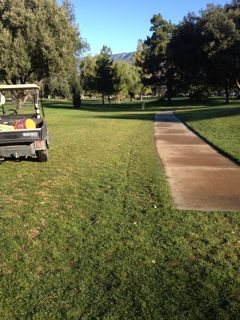
As the summer heat threatens to arrive, we will continue to diagnose and address some chronic areas of weak irrigation coverage. Several sprinklers will be added and a few relocated to allow for better application, thus better turf conditions. Please remember that the system age, inadequate pipe size, and limitations such as tree interference will always pose problems and account for the dreaded "brown spots" that you will begin to see as summer sets in.
Irrigation Spacing
In the southwest region of this country, an irrigation system is one of the most critical components of a golf course. Of the many components that comprise an irrigation system, the sprinkler head is responsible for applying water to the turfgrass. Many factors impact the performance of a sprinkler and one that has been identified as an issue at Arrowhead Country Club is spacing. We spent several months last season measuring triangulation and relocating the sprinklers that water the green's surface. The Toro 700 series sprinkler present on the course is capable of a 70' throw at 65 psi with correct nozzles. What we discovered was that every green had a minimum of one spacing issue and that most sprinklers did not have the correct nozzles installed to provide specified performance. The head spacing distances ranged from 58' to 96'. The photos below indicate correct and incorrect spacing and how that can impact water application.
Stretched spacing:
Correct spacing:
New Irrigation Satellite Installation
The new Toro VP irrigation satellite controllers have arrived and are currently being installed utilizing in-house labor. The securing configuration of the new controllers is consistent with the bolt configuration of the old Motorola DR2 controllers, which allows for a relatively quick interchange. We have installed 16 of the 26 satellites to date and hope to finish the project by the end of January. The upgrade to the VP controllers will allow for current course conditions to be maintained without fear of satellite failure. The old Motorola DR2 controllers contained components no longer available in the marketplace and represented a large challenge if rendered inoperable. The DR2 system allowed for a maximum of 32 stations per satellite and a majority of the stations operate three plus irrigation heads each. Worse case scenario, when a satellite went down, 96 irrigation heads would have to be operated manually at the head. As you can imagine, that would consume a vast amount of man hours and could potentially impact a large area.
Subscribe to:
Posts (Atom)


