Another Pump Station Upgrade

If you haven't gathered from my multiple posts regarding irrigation, it is a very important component to golf courses located in the South West Region.  The programming of the central computer and field satellites are only useful if a water source, electricity, a pump station capable of supplying the demand, and field piping infrastructure are present.


A pump station typically contains primary components including a CPU panel (with it's own software), high horse power motors, pump bowls, and intake and discharge pipes.  At certain points in an irrigation cycle the demand will exceed the performance of a motor/pump and a second motor/pump will be called upon to account for this demand.  In this situation, a high pressure window can occur (especially in our circumstances here where we do not have a VFD to operate our motors).  The newest addition to ACC's Irrigation pump station is a 3" High Pressure Relief Cla-Val.  This apparatus discharges water/pressure from the mainline pipe within the pump station when the pressure reaches a set "high pressure" point.  This is a safety mechanism in place to protect over pressurization of our old piping system and limit the pipe breakage that can result from repeated high pressure situations.


Tree Roots

After removing key Sycamore Trees from strategic locations adjacent to the practice putting green, we now must address the "quirky" irrigation layout.  In the photos below, Alejandro is relocating a full circle irrigation head to the outside edge of the chipping green.  Running irrigation piping under golf features is a sign of poor design and installation.  (See post identifying pipe running through the bunker on Hole #3 green surround).  In the coming weeks, the entire irrigation layout surrounding the practice putting greens will be renovated.  

As you can see in the image below, tree roots are definitely present in the green profile and love to follow irrigation pipes.  The bottom picture shows how a large tree root was encircling the irrigation pipe as it navigated deeper into the green profile.


Core Aerification Process

This past Monday, the Greens were core aerified and heavily topdressed with sand.  The photos below illustrate the process, which takes a full twelve hours to accomplish.  We core aerify the greens once per growing season.  This cultural practice is scheduled in the spring to improve water infiltration and increase field capacity of the profile.  The benefits are reaped in the upcoming heat of the summer.  Aerification is a "mandatory" surface disruption that allows for the exceptional surfaces that the membership experience throughout the other forty seven weeks of the season.  I say forty seven weeks, because the healing process will take approximately five weeks from coring to re-established perfection.  Improvement will be noted daily.  Soil temperature and weather can impact the recovery period.  If it is cold the recovery process is slower.  The idea of delaying core aerification until April (when both air and soil temperatures are higher and day length is longer) has been discussed by the Green Committee and will be decided upon in the next few months. 

Process:


1.  Coring the greens via walk behind machine with 5/8" O.D. (Outside Diameter) tines to a depth of 4".
2.  Hand removal of cores.
3.  Blowing the greens to remove excess debris.
4.  Rolling the greens to achieve a smooth surface for sand applications.
5.  Applying sand via a topdressing machine to a volume enough to fill the holes and blanket the surface.
6.  After the sand is allowed to dry, the sand is brushed into the holes via a drag brush attached to a utility cart.  Subsequent hand brushing is utilized to address sand depth consistency.
7.  Water is then applied to assist in the settling of the sand and to adequately hydrate the plant for recovery.
8.  Nightly watering assists in sand settling.
9.  Roll the surface and mow when Bentgrass growth peaks through the sand.  (Roughly one week after Sand application)


Plus One

The spacing of irrigation heads at the approach on Hole #17 has been an issue that we have spent many hours masking with hand watering over the past few seasons.  This March, we relocated a few heads to shift the triangulation, and installed an additional full circle head to correct distribution uniformity issues.  This project was completed in a few hours, prior to play, and was barely noticeable when completed.


Dig Deep Enough and You Will Discover...

The bunkers have been a hot topic during my tenure here at Arrowhead Country Club.  It is gratifying to know that when I first arrived, the directive from the Green committee was to:  "Make it through the summer with the greens."  Now we spend a majority of our discussions on what in the golf world is considered, a hazard.  At the risk of deviating from the post, I would like to focus on bunker drainage.  As many of you can attest, the bunkers do not drain well after a weather event.  

After searching the archives, I found that the bunkers here at ACC were renovated in 2000 by an outside contractor.  That contractor was said to have installed "drainage" in numerous bunkers.  The bunkers on Hole #2 are included in that list and as you know, do not drain correctly.  After years of experience in construction, here are a few things I found fault with:

1.  The pipe selection.  The pipe installed was primarily developed for leach bed applications, not golf course drainage.  The pipe utilized could be purchased at any local hardware dealer and consists of a series of dual holes located on the bottom portion of a polyethylene shell.  N-12 would have been the correct application.  N-12 is a world standard, double walled, perforated, corrugated polyethylene drainage pipe with a smooth walled interior.  It is rigid enough to handle the weight of traffic and is more more accepting of water with the design.

2.  The trench width.  The trench was cut 6" wide to bed a pipe 4" in diameter.  This leaves very little room for error or gravel installation on each side of the pipe.  A minimum 8" trench should have been cut to allow for 2" of gravel on each side in conjunction with 2" below and above the pipe.

3.  The low point.  Drainage should be trenched into the lowest point of any bunker floor.  This point should be located where the sub-floor collects.

4.  Sand Quality.  If poor quality sand (containing high silt/clay percentages) is present, the drain will fail regardless of depth of sand and installation practices.


Pipe Utilized
N-12 Pipe


A Helpful Tool

If any of you are planning a project or just looking to verify a quantity or square footage, visit:

I recently utilized the application to verify the surface acreage of the lakes present on the course.


Putting Green Shade versus Light

Many people have expressed interest as to why three Sycamore trees were removed from the surrounds of the practice putting greens.  An earlier post containing video narrates the primary reasons, but the pictures below say a thousand words.  The Sycamores close proximity to the putting surfaces allowed for root competition for water and nutrients, provided high volumes of shade (especially in the winter months with their southern locations), and funneled traffic to narrow corridors on an already undersized green.  Turfgrass requires high volumes of light to handle to the wear and tear of play.  The putting green sustains the highest volume of traffic of all greens on the course.  Combine lack of sunlight and high volumes of traffic and turfgrass decline is almost always the result.  As an example, when you are out on the putting green, look at the turfgrass quality on the northern side and then compare it to the southern side.  I am willing to bet that after inspection, even the untrained eye will note a difference.  

Be sure to note the improved density and quality of Bentgrass in the coming weeks now that the trees have been removed.     

Shade present prior to Sycamore removal
Light After Sycamore removal
Tree Decay within the Sycamore:  Future Danger


A Project Here, A Project There...

With the cool temperatures and our mowing frequency this time of season, we have the luxury of completing a few minor projects that have blessed "the list".  Do not be mistaken, the list never shortens.  We make our best effort to cross off an item, just after we add one.  

This past week's project was to install a drain box, drainage, and a drain sump along the cart path north of Hole #10 tee.  This area is a low in the cart path and surrounding grade, which has been a perennial trap for water.  


February Roots

A photograph illustrating the healthy, root depth on a portion of Hole #2 green.

Elevated Tree Trimming

The 60' Man-Lift, critical in the removal of the trees over-hanging the putting green, was also utilized to perform the bi-annual trimming of the Palm trees on Holes #10 and #15.  In addition to the Palms, the wind damaged Oak west of #11 tee was also pruned utilizing the machine.  


Continuing Relocation

With the irrigation season quickly approaching, we continue to relocate irrigation sprinklers.  This part circle, greens back-up head, was relocated to the edge of the collar on the north side of Hole #12 green.  Multiple back up heads are slated to be moved this spring. 


Another Interesting Discovery

It is always fun to find water bubbling up inside a bunker.  A major "no-no" in golf construction is to install irrigation pipe under or within a green or a bunker.  The damage due to a pipe failure could be very costly and take a feature out of play for the day or more.  As you can see by the photos, irrigation pipe runs through the right side bunker on Hole #3 green here at ACC.


This irrigation pipe relocation goes on the list of irrigation items to be addressed in the upcoming weeks, right below relocating the irrigation pipe that runs through the east side of the practice putting green.


Trees, Trees, Trees....

With the removal of the three Sycamores adjacent to the putting green, that leaves 999 trees on property.  Evaluation and upkeep is a costly and time consuming process.  Trimming dead wood, low branches, and removal of suckers is a job that has been performed for many years by long tenured employee, Luis Franco.  Luis does a tremendous job with this task and could probably tell you a story about nearly every tree residing on property.

One years worth of tree trimming

Luis' Best Work

Luis in action

Irrigation upgrade

As mentioned many times previously, the irrigation system is in dyer need of an upgrade.  Given the cost of a total renovation, we must and have addressed this situation, one step/component at a time.  The past two season have been spent relocating sprinklers, correcting triangulation, and creating efficient programming.  This January, due to a failing 32 year old Toshiba pump/motor controller, we were forced to upgrade to a Watertronics control panel.  I say "forced" because we had exhausted all alternatives in keeping the old panel operational.  Next in line for upgrades will be a VFD drive for our 75 hp pumps, which should extend the life of our motors and pumps, as well as conserve electricity.  Our electricity costs are slated to increase 1.9% to 4.4% above last season.

The new panel

Removal of Trees Surrounding the Putting Greens

For those of you that have expressed interest in why specific Sycamore trees were removed adjacent to the putting and chipping greens, below is an informative video that for the most part reiterates my comments:


Tree Inventory

This January, I have counted and identified the volume of trees that reside at Arrowhead Country Club.  The total number is 1053.  The charts below identify percentages and total counts per Genus.  I will admit that I have some identification work to do within the miscellaneous category, but this may give you a glimpse into the leaf/debris issue that we battle every fall/winter.


To Mow or To Roll?

Growth rates, seasonal climatic conditions, moisture, and desired green speed dictate the answer to the topic question.  Depending on the variables of these factors, we decide whether to cut the greens or roll the greens.  With a dominant monoculture of A4/T1 Bentgrass, we do not have to factor in the variance of two turfgrass growth habits. (ex. Bentgrass versus poa annua)  The decision is dictated by yield and performance.  Mowing is a form of mechanical stress to the plant and at certain times can be detrimental to plant health and density.  Why mow when you do not have to?  If water management and fertility are monitored closely, to the point of just creating enough growth to recover from the stress of play, mowing seven days a week or double cutting is not required.  


Many golfers say "We love fast greens!", but usually only a small percentage of Private Membership golfers demand these requirements and on the opposite end, speed can make rounds difficult and not fun for the majority.  Greens that are consistent, smooth, and true out-perform speed any day.  (In my opinion)  Without identifying courses or events, I believe most golfers feel the same way.  We do our best to maintain consistency throughout the various seasons that the Southern California climate may dictate.


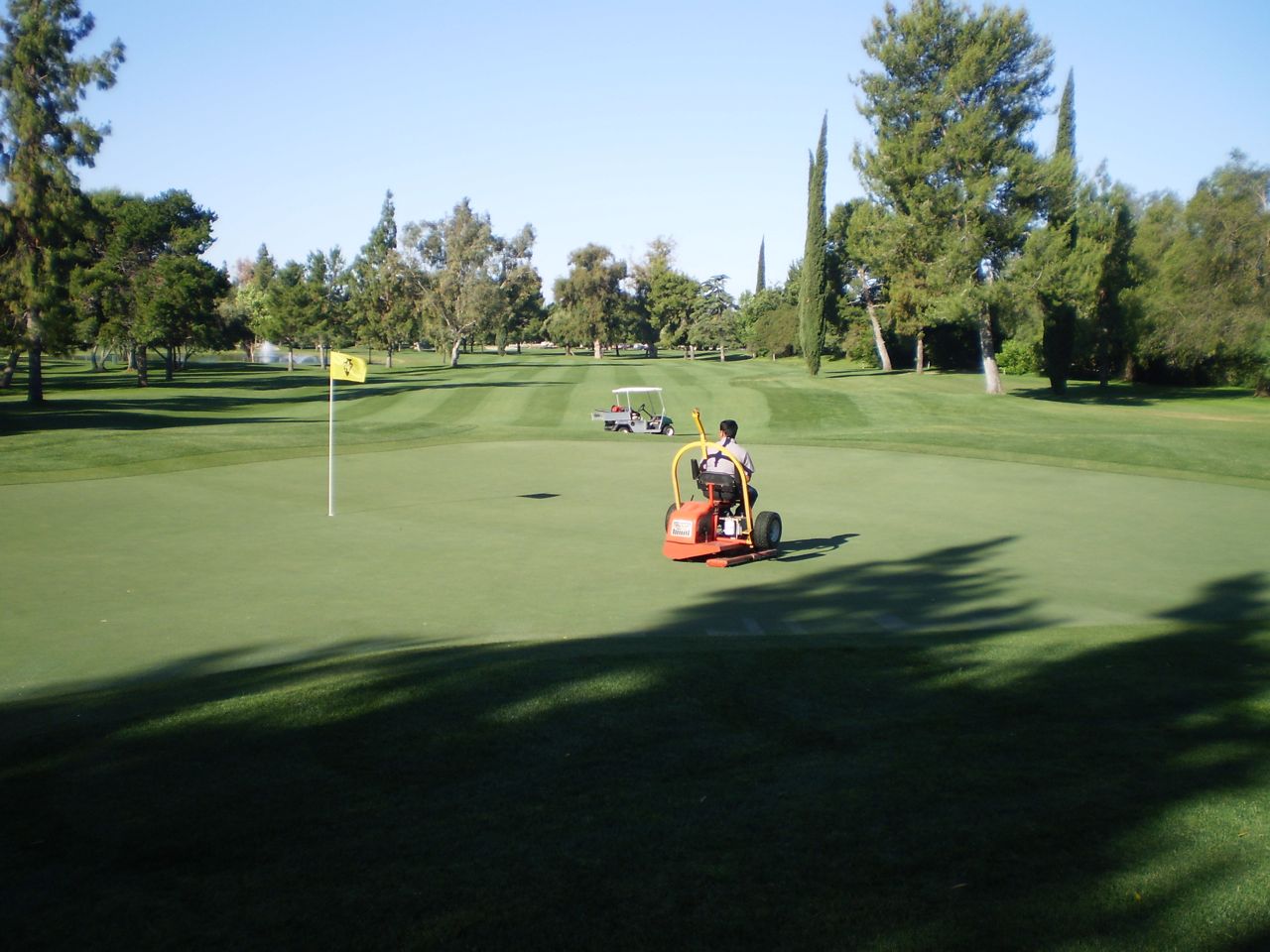
Alfredo Tri-plexing #18 Green

Alfredo Rolling #16 Green