San Bernardino County Water Conference 2011


This past Thursday I was invited to participate as a speaker and panelist at the San Bernardino County Water Conference in Ontario.  It was an opportunity to inform the community of our water conservation efforts on the golf course.  By introducing perpetual, comprehensive auditing to our conservation planning, we have conserved a volume of water equal to a 25% reduction from previous seasons (2006 versus 2010).  That equates to 60 acre foot of water per season.  Multiple additional components contribute to our conservation efforts including:  diligence in moisture monitoring, amended programming, hand watering versus overhead sprinkler operation, nozzle upgrades, and managing environmentally adapative species of turfgrass for our region. 

To visit the conference site, please click the link below:

Hydraulic Leak

We experienced our first major hydraulic leak in two and half seasons on Friday.  The leak occurred on the left side of Hole #1 in the intermediate rough.  The hose of was quickly repaired and the machine is back in operation.  A photo of the damage:


Soil & Water Testing

Every season we collect samples of the irrigation water and soil from select greens.  The samples are sent to accredited laboratories and processed for elemental properties.  It is wise to utilize the same laboratory from year to year because extraction methods can differ between the labs.  This is beneficial when it comes to accurately comparing data and determining if the agronomic plan needs to be amended to account for an alteration in characteristics.  Dissimilar from industry standard, we do not attempt to address all imbalances within the soil.  Since we have no interest in yield and strive to produce and manage a surface, wasting monies incorporating non-beneficial nutrients to balance the soil is not required.


(Several soil sample locations on #17 Green)

Missed putts?

After borrowing the idea from a fellow Golf Course Superintendent, I enlisted the assistance of a few members willing to donate their time.  (Thank you both, Mr. Fike and Mr. Lynch)

The project was to identify golfer's un-repaired or incorrectly repaired ball marks on one Par 3.  The photos below illustrate the several hundred un-repaired or incorrectly repaired ball marks on Hole #15.  This exercise took approximately 45 minutes and clearly identifies that members are not taking the time to fix their ballmarks.  


The heat of the summer results in a larger moisture requirement for proper plant hydration.  This will create a slightly softer surface than typically experienced at the club.  


The next time your putt shimmies offline, there is a high probability that it is the result of  a ballmark.  Please show ownership in your golf course and help us maintain the best possible surface.


July 2011 Roots

Proper management of Bentgrass in Southern California can yield dense, deep roots.  These photos were taken today, July 21st, on the thirteenth green.  Bring on the heat....


(triplexed greens cut at .095")

Five Year Difference

Similar locations, several years apart:

 #6 green

 #6 green

 #2 green

#9 green

New VFD Installation

The newest component to the irrigation system is a V.F.D. for one of the 75 horsepower pump motors.  The variable frequency drive eases the electrical load on a motor when 100% demand is not required.  This upgrade will save in electrical use, utility costs, and wear on the old hydraulic pipe system.


Mowing Practices

Several members have inquired about our mowing practices and frequency.  The short answer is that our mowing frequency is dictated by clipping yield and varies based upon time of season.  This time of the year (July) we cut the bermudagrass fairways, tees, and approaches two to three times per week.  In the winter months, the Ryegrass is cut once or twice per week depending on growth rate.  Consuming fuel and "burning-in" mowing patterns for aesthetics is a strain on the diminished budget and limits the man hours and energy we can devote to improvements and detail work in addition to unnecessary wear and tear to equipment.  In this industry, mowing is a very under estimated mechanical stress that negatively impacts plant health.  

Fairway Aerification

The fairway aerification process has begun and is scheduled to take place over the next two weeks.  Thank you for your patience during this critical cultural practice.


Practice Makes Perfect

The putting green is an area of practice.  It is always challenging to produce a "perfect" surface that emulates all of the greens when there is tenfold the amount of traffic and wear.  The image below illustrates the impact of a golfer's dedication to his/her game by practicing putting from a particular location for an extensive amount of time.  (Note the footprints)


Summer Landscape Upgrades

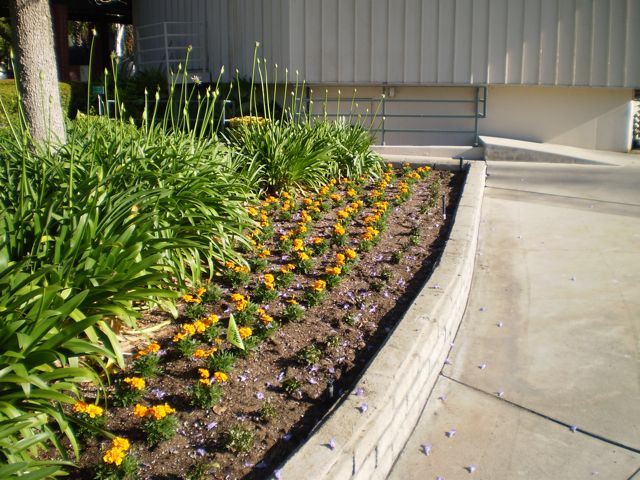
The summer annuals have been planted with a new addition created between the set of ladies tees on Hole #7.  The old, ragged junipers were removed and replaced with some summer color and transplanted garlic plants.  The new bed will not only enhance the complex, but improve the turfgrass surrounding the area by effectively removing the much taller and denser junipers, which impacted sprinkler trajectory.


The bare block wall protecting the swimming pool was enhanced by the planting of a row of  'Iceberg' roses to provide contrast and color to the long, monotonous structure.


Memorial Day 2011

Gratitude and respect to the countless numbers who have past serving this great country.


41st San Bernardino County Amateur Golf Tournament

This Sunday,  Arrowhead Country Club hosted the second round of the San Bernardino County Amateur golf tournament.  The final round will be held at San Bernardino Golf Club on Monday.  Scott Clayton, ACC member, three time winner, and defending champion has turned professional, so there will be a newly crowned champion this year. 

Defying the Odds

Three years and almost nine months later we are still managing 99.9% Bentgrass greens at Arrowhead Country Club in Southern California.  Industry speculators believe that this phenomenon cannot be accomplished and is not sustainable.  For Greenway and it's Superintendents, it is of no surprise.  In Southern California, where the seasonal time frame for poa annua establishment is long and pressure is high, most courses would be inundated with poa.  The sustainability is attributed to the correct management of Bentgrass from an agronomic and cultural standpoint.


More Etiquette & Knowledge of Golf Rules

A divot on a green is not acceptable and should not be something that one would expect to see at a Private Club.  I'm not sure why this happens every spring, but it is quite frustrating.  Please show proper etiquette and respect to the course and our hard working staff.  If you have a question regarding the rules of golf and your options when landing on a putting surface, please speak with the Golf Professionals to understand your relief.

Hole #11 Green-  April 27th, 2011


Invitational '11 Photos


Divot Repair

When filling your divots, please fill the divot level to grade and do not leave it mounded.  If excess material is applied, disperse the mound with your shoe.  Raised divot mix can dull the reel mowers utilized to cut the surface thus causing more stress to the turfgrass and additional maintenance.


As always- Thank you for your dedication to your course and it's upkeep, presentation, and playability.  

Incorrect divot repair (mounding) 

Correct divot repair (smooth and level to grade)